
A mother once described all the conversations she’d had with her 15-year-old son.
Drugs. Sex. Gangs. Street crime. Being out late in the city.
Water never came up, it was never really on her radar. Then one day her son saw a girl fall into a river and without hesitation went straight in to help. She got to safety, but he lost his life trying to save her.
“I wish there had been a conversation with him about what to do in an emergency in water, and how to keep yourself safe,” she said.
This is one of the stories relayed to us from Kirsty Aitken, the chief executive of the Darcey Sunshine Foundation, a Scottish charity that teaches children in four countries what to do when they end up in water they didn’t plan to be in.
That missing conversation is one of the many important pieces of work the foundation undertakes every day. And the Winter Sunshine Ball is a key part in continuing that work.
The Winter Sunshine Ball is at the Crowne Plaza in Glasgow on 7 November. Tables of 10 are £1,000, and you can book here.
The foundation was set up in memory of Kirsty’s daughter Darcey, who was three years old when she lost her life to drowning. It still operates in South Africa, where they lived at the time.
A month after Darcey died, the world went into lockdown. Schools in the communities around Somerset West closed, which meant thousands of children lost the only meal they got in a day.
On what would have been Darcey’s fourth birthday, one of the family’s closest friends started the Sunshine Sandwich Project. It began with a couple of people buying loaves. It ended up with neighbours making baby food and more than 1,000 sandwiches going out every day.
“One day we had an entire pickup truck filled with apples arrive at our door,” Kirsty says.
The swimming idea came from Darcey’s own swim teacher, Jo-Anne Grobler, on a walk along the beach.
Kirsty’s answer, at first, was no.
“We taught Darcey to swim, and she still drowned.”
Then came the thoughts of all the different ways it could have been prevented.
“We’ll teach kids to swim. But we will teach them safety around water first and foremost. I don’t care whether they can swim lengths or whether they’re going to be the next South African swimmer. I want them to be able to fall in the water and climb back out again.”
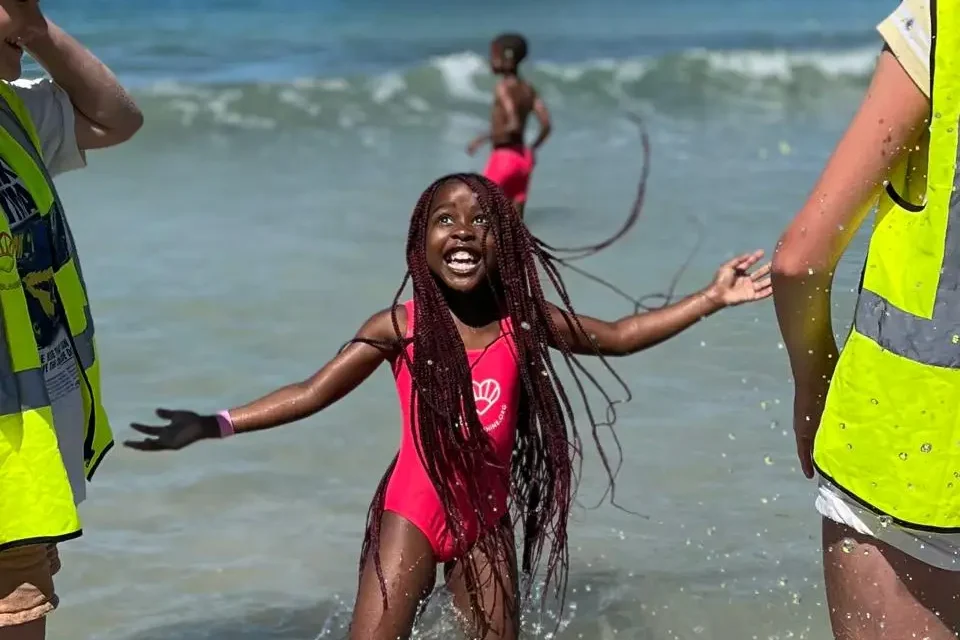
Six children started that first year. Then 56. Then 180. Now it’s 300 a year, and more than 1500 children have come through the programme since 2021.
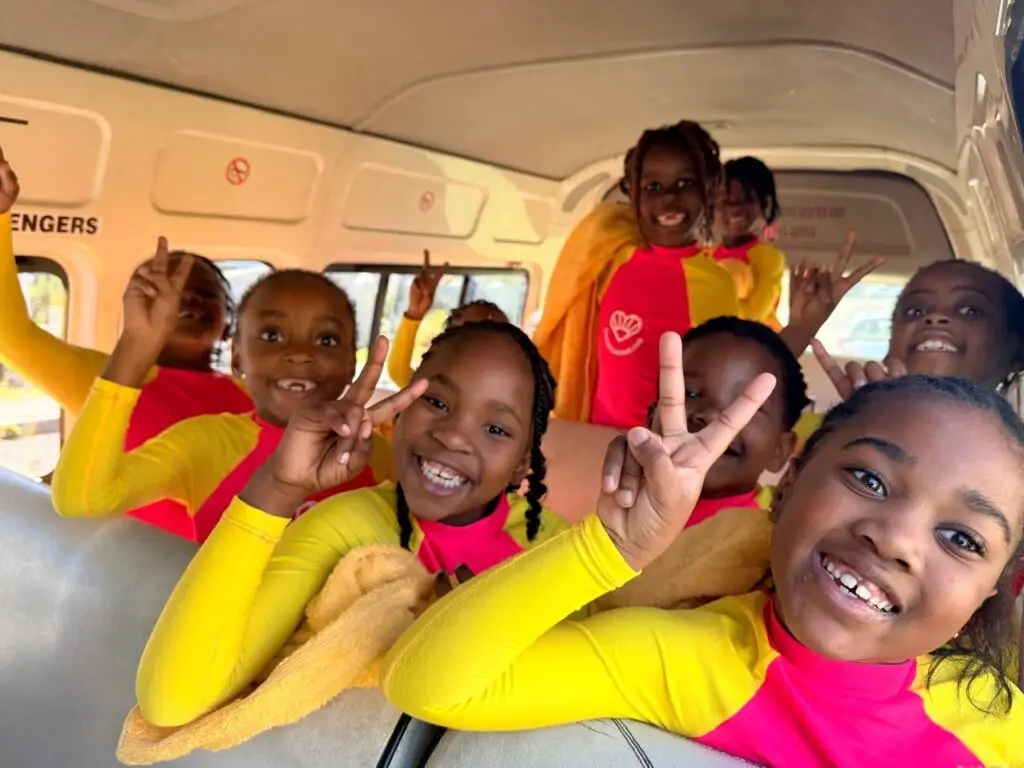
The foundation’s focus is not to teach children to swim, it teaches them to survive.
Turn onto your back, float, shout for help, buy yourself time. Ask an adult before you go near water. Never go alone.
Kirsty has a good way of explaining why that distinction matters.
“We would never teach a child to ride a bike in a safe field and then expect them to navigate traffic and stop signs. But with swimming, we teach kids in nice visible warm water, with an instructor or a lifeguard there.”
Then they meet a loch, a river, or the sea with uneven ground, moving water and the cold that changes what their body can do. The skills they learned through swimming lessons don’t transfer, because nobody taught them the difference.
Which is why the theory comes first. Taught through workbooks and stories about Sunny the seal pup and Sipho the starfish, before a child gets near the water.
There’s also a nutrition element, because children can’t learn hungry. Every child also gets their own costume, cap, towel and bag, which for a lot of them is the first swimming kit they’ve ever owned. The teachers who hand out the bags say it’s the best day of the year.
South Africa is where it started and where the biggest programme still runs, delivered with local swim schools and pre-schools by a part-time programmes manager and a couple of assistants. Last year 300 children went through the full programme, and 5,000 more got water safety education in their classrooms.
Zimbabwe came about because a swim instructor in Harare was already doing the work. She gives free lessons to children of domestic workers, to children with additional support needs, and to the children of single mothers. She asked to be part of something bigger. The foundation supports her with safeguarding training and the water safety workbooks, while local fundraisers cover the kit.
In Mauritius the focus is on training up more instructors, who then teach children in their own communities. They learn in the sea.
And then there’s Scotland.
Moving back to Scotland, Kirsty found that 40% of children leaving Scottish primary schools were unable to swim.
“I took it for granted, because I got swimming lessons at school. I just thought that was part of the course in Scotland.”
So the work here now runs on two tracks: teaching children directly, and campaigning to make that teaching universal.
The teaching is built on partnerships with Xcite West Lothian, Fife Active Schools, a handful of private swim schools and community organisations across the central belt of Scotland. That means open water safety days for 12 to 18-year-olds, and swim bursaries for children who can’t access mainstream lessons. Recently it meant two weeks in St Andrews, with primary fives split between the pool and the beach, spotting hazards you might find at the coast and what a cold sea does to a body.
The campaigning put the foundation in the Scottish Swimming’s Save our Pools Campaign, a campaign that petitioned the Scottish Government and helped lead to the roll-out of school swimming. It sits on Water Safety Scotland alongside the RNLI, RLSS, Education Scotland and Scottish Swimming, where Kirsty is vice chair of the education subcommittee.
The goal there is simple and not yet won: every child in Scotland taught water safety as part of the curriculum.
This summer made the case for it.
“During the heatwave, I would dread opening my phone.”
Even in warm weather, the water is cold. Cold water shock takes strong swimmers too.
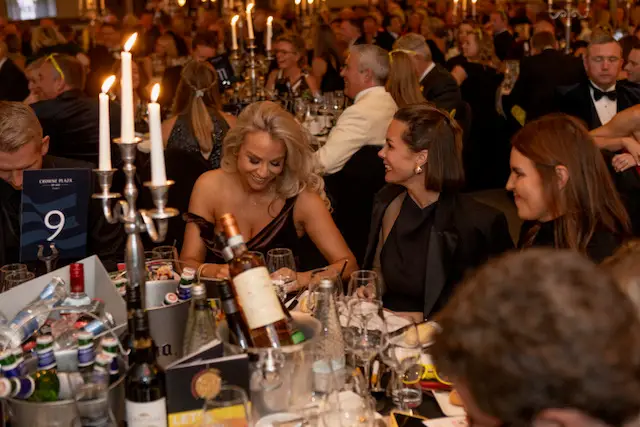
This is the fifth Winter Sunshine Ball.
The first two were at Òran Mór, and those rooms were small, intimate and emotional. The night has grown since then, but the feeling in the room hasn’t changed much.
A drinks reception in the Argyle Suite, then dinner, with actress Jules Wilson Nimmo hosting and comedian Fred MacAulay leading a live auction. After dinner Kirsty gives the rundown of the past year and the impact made from the previous year’s ball.
Then surprise entertainment, a live and silent auction, a raffle, a tombola sponsored by James Porter and Son, and a fantastic band to play everyone into the night.
Almost everything above was paid for by one night last November.
“When you sit at the end of that year and actually look at the impact that’s been created from the ball the year before, it blows my mind every single time,” Kirsty says.
Tables of 10 are £1,000.
“When you go to a fundraising event, you wonder how much of an impact that £20 you put in the envelope is actually going to make to that charity. For this ball, it is everything.”
A full programme for a child in South Africa costs about £120. A swim bursary for a child in Scotland is closer to £500 a year, because the level of support each child needs is different.
The money raised in one room also covers the parts of a children’s charity nobody thinks about: safeguarding, governance, somebody in post to make sure every child who comes through is protected and cared for.
The target this year is £70,000. Last year’s £90,000 was a record, and Kirsty would take it again in a heartbeat, but £70,000 keeps the current programmes operating.
“If there’s one evening where you can guarantee you’ll leave absolutely beaming, and know it’s made a massive difference to what is a really small charity – it’s this one.”
The Winter Sunshine Ball is on Saturday 7 November at the Crowne Plaza, Glasgow. Tables of 10 are £1,000, and you can book on Forumm. If you’d like to come but can’t fill a table, get in touch with the foundation directly.
The Darcey Sunshine Project is a Scottish charity, SC052031.
Board of trustees: Greg Smith (chairperson), Karen Haxton, Kirsty Fulton, James Klinge, Kimberley Hamilton-Linning, Karina Reinhardt.
Fundraising committee: Karen Haxton, Kirsty Fulton, James Klinge, Kimberley Hamilton-Linning, Lorna Muir, Wendy Coakley, Caroline Strachan,.
Every one of them gives their time to this for nothing.